Table Of Content
- New to UX Design? We’re Giving You a Free ebook!
- New to UX Design? We’re giving you a free ebook!
- ASU linguist is outstanding humanities grad
- Designing for User Goals and Behaviors
- The five dimensions of interaction design
- Library design can promote social interaction
- The Role of AI and Machine Learning in IxD
These designs give products a competitive edge by satisfying functional needs while also improving user experiences. In the end, good interface design makes technology indispensable in the digital age by enabling meaningful connections between people and the device. User experience designers apply UX fundamentals like design thinking, human-centered design, and user research to make decisions. They’re specifically concerned with a user’s tasks, actions, and environment, while interaction designers focus on making the digital product respond to user actions in an appropriate way. They tend to think about what happens when a user clicks a button, types a phrase into a search bar or hovers over an image.
New to UX Design? We’re Giving You a Free ebook!
The Interaction Design Foundation (IxDF) is an educational organization advancing design knowledge and capabilities. We offer over 30 comprehensive courses on user experience (UX) and interaction design, suitable for both novices and experienced designers. Learn and evolve with our diverse courses and enhance your design proficiency, earning industry-recognized certifications. These dimensions are pivotal in creating clear, user-friendly, and effective interactions. To create interactions that are intuitive, efficient, and user-friendly, interaction designers adhere to certain principles and best practices. Gillian Crampton Smith, a pioneer in the field of interaction design, outlined four key dimensions of interaction design.
New to UX Design? We’re giving you a free ebook!
When implementing interaction design, one thing to consider is knowing the types of users you’re designing for first. You can achieve this by researching your market surrounding user goals, behavior and personas. After completing the research, start thinking about a design strategy to help you achieve your goals.
ASU linguist is outstanding humanities grad
Indicating an available interaction, they flash green lights at the user shouting, “Here I am, you can tap (click, swipe, etc.) me! ” An affordance may exist in the UI, but may stay hidden because if it lacks a signifier, it remains invisible. An example might be a “hidden gestural interaction” that doesn’t reveal itself unless the user accidentally swipes left or right (to delete something, for example). Experience is critical, for it determines how fondly people remember their interactions. There’s a fine line between an interaction that works and one that is unusable.
Designing for User Goals and Behaviors
The 5 Pillars of Interaction Design - TNW
The 5 Pillars of Interaction Design.
Posted: Tue, 03 Mar 2015 08:00:00 GMT [source]
To master interaction design, follow our Interaction Designer Learning Path, and explore our Product Manager Learning Path for a comprehensive understanding of constructing user-centric products. By integrating insights from both paths, you can innovate products that are functional and user-friendly and meet market demands. Fundamental interaction design principles will always play a central role in the design of future systems and it’s important for UX/UI designers to keep them in mind.
The five dimensions of interaction design
Interaction designers focus on creating engaging and meaningful relationships with people through the products and services they use. Essentially, they help businesses create user-centered designs—focusing on the consumer’s needs in every aspect. This part of the design places a strategic focus on users’ reactions throughout their experience. So, whenever you think of improving a product, interaction design will enhance usability, brand identity, structure and interactivity—by incorporating the appropriate visual, motion and sound elements.
Library design can promote social interaction
Interface standards don’t stifle creativity—they are not hard and fast rules, but foundational guidelines that help a designer establish a “usable and familiar design” base from which to innovate. Following interaction design principles contributes immensely to great interaction design, which in turn will contribute to the experience. In the final lesson, you’ll step outside the classroom and into the real world.
Designers focused on creating an interface that not only motivates runners but also ensures their safety by minimizing distractions. This means avoiding overly detailed text or complex navigation that could be hazardous during physical activity. Similarly, heuristic evaluations by design teams can quickly pinpoint and prioritize the correction of glaring usability flaws to enhance the user experience without significant delays. Applying the Interaction Design (IxD) process in real-world contexts requires navigating through its five stages, ideally without compromise. However, real-world projects often face time and financial constraints, which necessitates strategic trade-offs.
For this reason, designers shouldn’t deviate too far from convention; for example, a right-facing triangle almost always represents a play button. The more a signifier deviates from convention, the more effort it takes to decipher what it is. If the results come back with ideas or improvement areas, the designer can make the necessary changes, correct the problem or rethink the experience to make it better. Cognitive dimensions have their own common vocabulary — referred to as notations — to help guide the process. For more information, read our research on the 4-step process to improve the usability of web surveys. UX is how a user interacts with and experiences a product, system, or service.
Additionally, a well-designed website can bolster customer satisfaction and loyalty, leading to increased repeat business and positive word-of-mouth marketing. Forbes states that the ROI of user experience design is an enormous 9,900% – where for every $1 spent, brands can expect a $100 return. This can include designing the layout and navigation of a website, the user flow of a mobile app, or the physical buttons and controls of a piece of hardware. UX design (similar to interaction design) on the other hand, tries to understand the design of a system with the user in mind. Interaction design also includes a strategic focus on how users interact during an experience and how that can be managed, rather than just focussing on how to format and design the technology for use. Variables allow designers to capture user inputs and use that data elsewhere in the prototype–like a personalized welcome message after completing an onboarding form.
As we noted before, it’s nearly impossible to identify someone as “only” an interaction designer. The field overlaps with UX design, UI design, development, and visual design, and as a result not all the designers listed here even refer to themselves as interaction designers. We’ve included them because of their impact on the field, and because the things they have taught and written about are worth exploring if you yourself work in interaction design. You should take this course if you belong to a team whose goal is to create a great product—whatever role you play in that. The fact of the matter is that usability experts and UX designers are just the tip of the iceberg when it comes to the people who influence the design of a product.
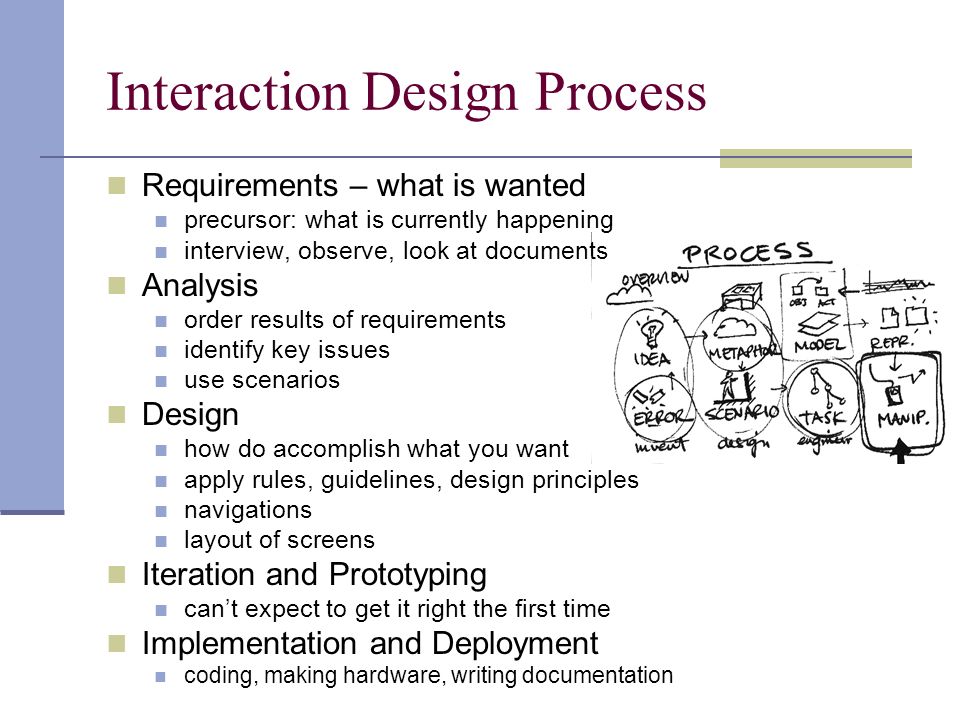
Mastering this process of interaction design, with its techniques and tools, is key for designing digital platforms that resonate with users and feel as comfortable as second nature. In the following sections, we'll explore the role of an interaction designer, real-life examples of effective interaction design, and emerging trends in the field. The process of interaction design plays a crucial part in shaping the user experience. The journey of creating user-friendly systems starts with understanding the user's needs, translating them into designs, and refining them through iteration.
These subtle movements and responses add depth to the user experience and make the interactions more engaging. It involves gathering feedback from real users who interact with your prototypes. Providing timely feedback to user actions and creating responsive interactions are key elements of interaction design. General Assembly’s Visual Design course helps you explore the art and science of visual communication and the process of creating beautiful digital products. Create a production- ready composition for a responsive webpage, conveying your vision through typography, layout, and color.
This could relate to having a consistent design that the user can understand quickly and anticipate with ease. Or ensuring your product is discoverable and can be learned in a timely fashion — but all of those are a given. Here is the most important concept when ensuring your interaction design is user-oriented.




No comments:
Post a Comment